Pinned

“This is AI and could be wrong” isn’t good enough for my money
According to the Financial Times, general models get personal finance wrong 57% of the time. I joined Haido to build AI chat that’s accountable for every number.
Pinned
According to the Financial Times, general models get personal finance wrong 57% of the time. I joined Haido to build AI chat that’s accountable for every number.
According to the Financial Times, general AI models get personal finance wrong 57% of the time.1
I witnessed this myself when I used general AI to help plan my financial future. It was a mess with numbers that didn’t add up and kept changing.
I’ve spent the last 5 years as a product owner building deployed AI systems in the regulated recycling industry and have my MSc from Imperial. I joined the Haido founding team to build a product that customers like me need combining the convenience of AI chat with numbers I can rely on.
Numbers you can rely on for us means owning the responsibility for good customer outcomes and not relying on quality disclaimers when it comes to people’s money. We’ll be doing that from day 1 whilst also applying for UK regulatory authorisation in 2027.
Introduction
I had a conversation with a friend recently where they said something seemingly innocent:
“[AI chatbot redacted] has been sorting out my finances for me.”
When I pushed back to say this was a horrible idea they responded:
“Why not? AI is replacing knowledge jobs at banks, beating humans in logic games, designing new medicines, solving complex mathematical problems and more. My finances must be something it can handle.”
My friend isn’t alone. In August, an FCA study found that 56% of 18-40 year olds who invest or plan to trust AI tools more than TV, radio or the press, and 44% wrongly believe AI generated financial information is regulated.2 Weeks later, the FCA’s Jessica Rusu called on AI providers to add clear disclaimers, warning that only 40% of consumers realise they have no recourse if something goes wrong.3
If you’ve done the same as my friend, I highly recommend that you double check what your AI has told you and stop, or at least change, how you use general AI with your finances.
The truth is that AI systems available to consumers are simply not reliable when it comes to financial support. When they inevitably get it confidently wrong, there is no recourse.
Below I review the 3 main reasons why I think general AI is getting it wrong:
Risk 1 of 3
To understand why you should be cautious when asking general AI for financial advice, it’s important to first understand the fundamental difference between general AI and a calculator. The two flow charts below show side by side what happens inside of a calculator and general AI (LLM) when you ask either to perform a simple calculation.
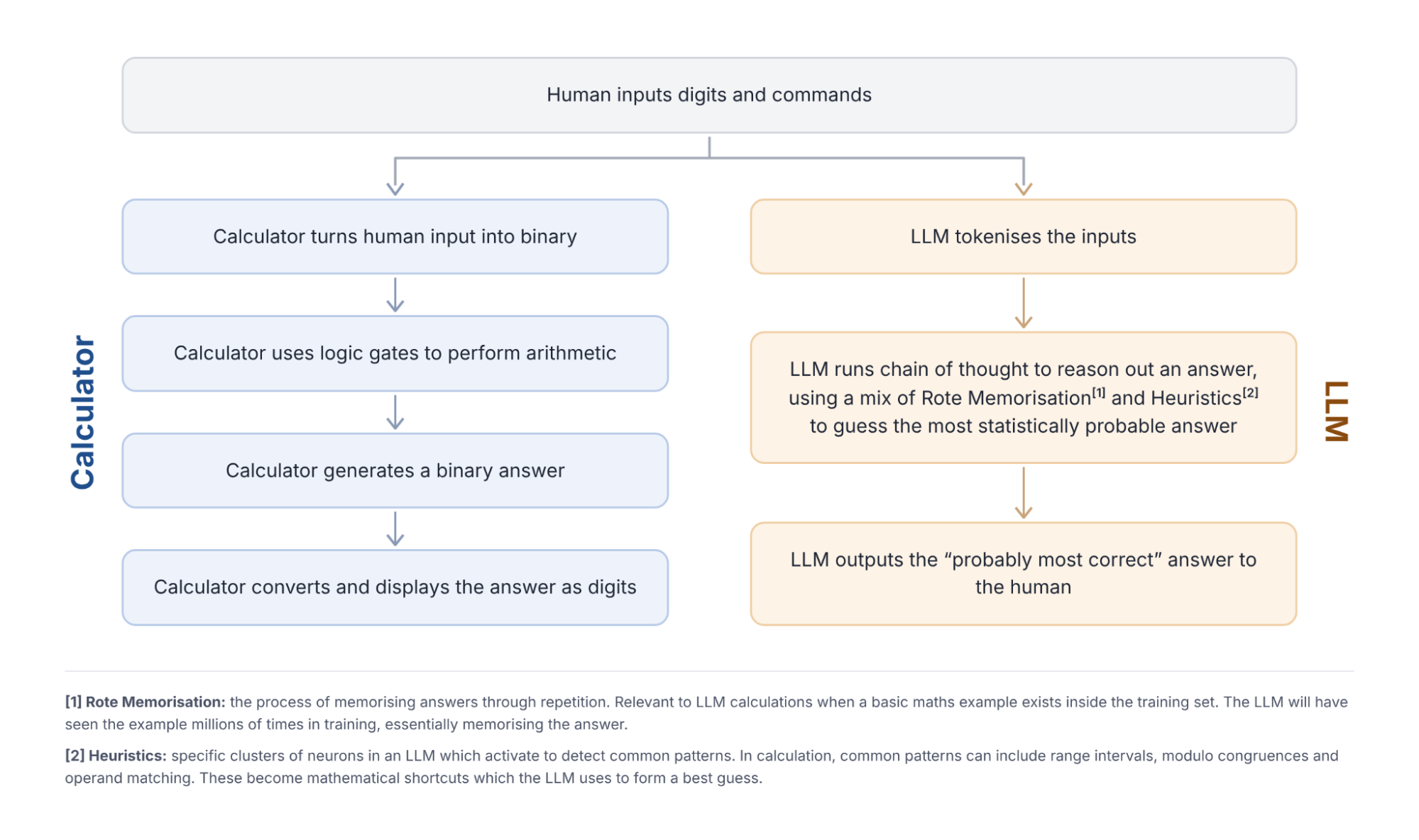
Every step in the general AI flow after your input is a potential source of error. General AI models are trained to see everything as linguistic fragments rather than numerical values. To general AI, words and digits are handled the same; both inputs are tokenised, split into common parts, and fed into the model as a matrix. This on its own is a core limitation to performing mathematical operations. Because an AI sees numbers as chopped-up text fragments rather than actual mathematical values, it is performing functions closer to pattern matching than arithmetic.
With simpler calculations, there is a high likelihood that the calculation exists written out in the model’s training data. However, even with millions of examples in training data, this becomes less reliable as the numbers get bigger and the steps multiply, and crucially, nothing warns you when it goes wrong. Try it yourself and you’ll probably get the right answer, but “probably” is the problem. A financial plan chains together dozens of calculations, and at 99% accuracy per step, a 50-step plan comes out fully correct only around 60% of the time, with nothing flagging which number is wrong. Across millions of users, even a 1% error rate means thousands of people acting confidently on bad numbers. Some chatbots can call a calculator but there is no guarantee that they do and you often can’t tell when they have. It also doesn’t fix a wrong input or an outdated rule, which leads to the next risk.
Risk 2 of 3
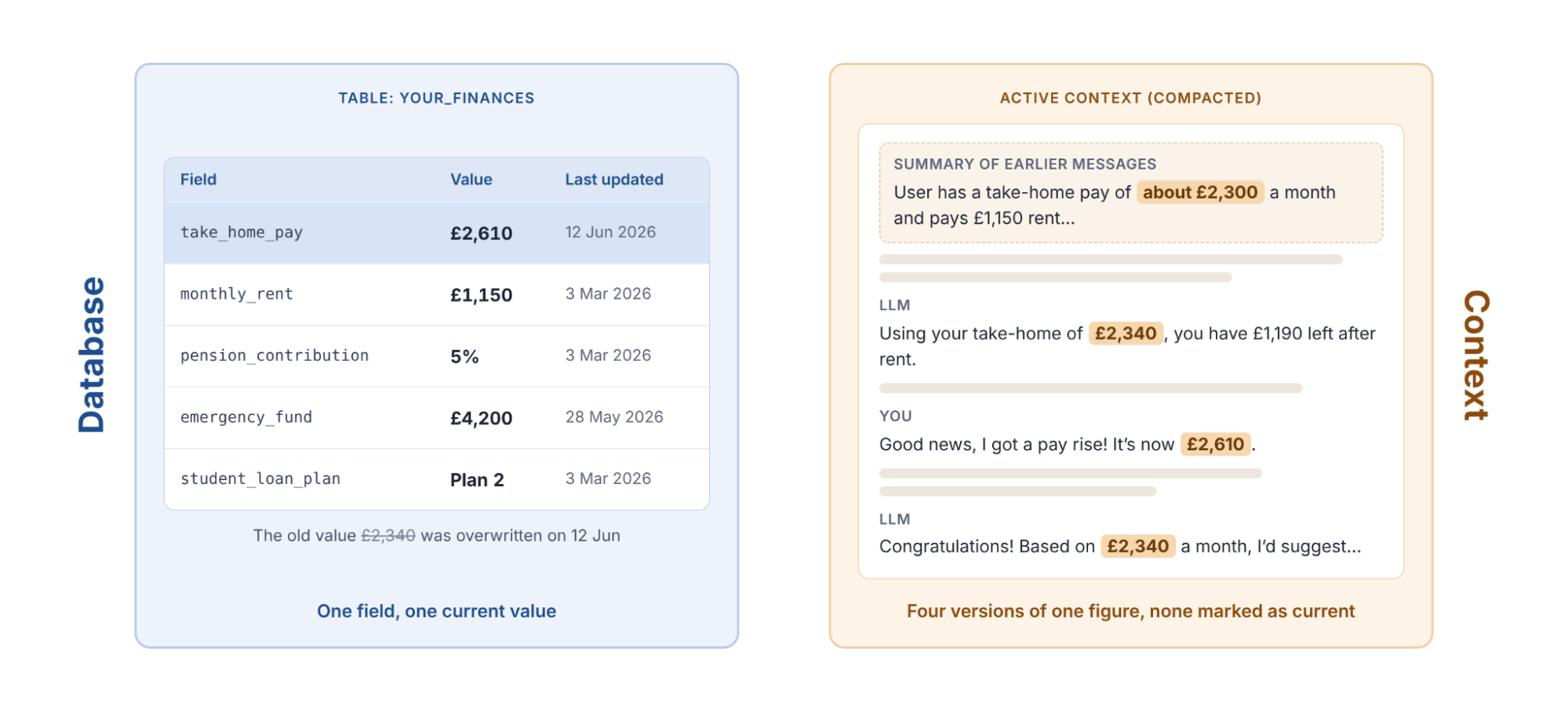
The next biggest risk comes from the fact that general AI conversations are not storing values explicitly in structured databases. Instead, all of the data provided to the AI over the course of multiple conversations is stored in context. The technical explanation of how context works is too long to go into here, but there are important limitations to storing information this way. The first problem compounds our previous risk: context is not just what you put in, but also what the AI responds with. If the model calculated an incorrect figure once, that figure is now in the context and part of what the model will use as ground truth for all further answers.
The second problem is that context is not a reliable memory. A database stores your input once, exactly, and when it changes or updates in the future the old value is replaced. Context works more like a long transcript. Let’s say you want to use general AI to ask a question about your salary. To the AI, your old salary, your current salary, a potential future salary and every figure the model has worked out along the way all sit side by side, and nothing explicitly marks which one is relevant to the question you’re asking. As conversations grow, models are also known to pay less attention to details buried in the middle, and once a conversation gets too long, older parts are summarised or dropped altogether. “Memory” features that carry information between chats typically store short notes rather than exact figures. So while the AI can store the words and numbers mentioned, it lacks the structure around those numbers to establish explicit provenance of who said what and exactly when. Without this structure, models can easily recall the wrong figure leading to more possible errors.
Risk 3 of 3
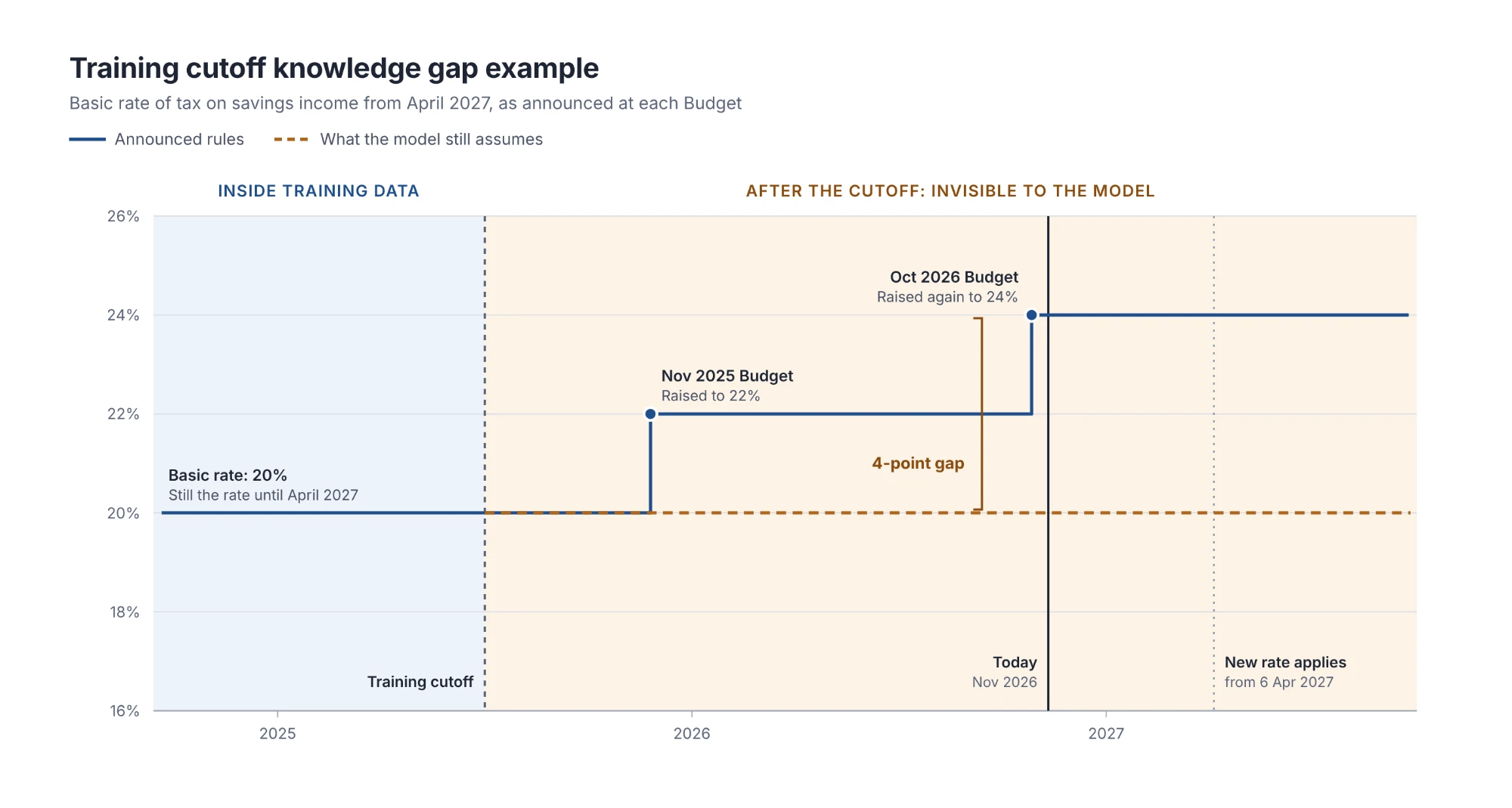
The next risk comes from the fact that general AI models have training cutoff dates. The brain that is driving the logic and decisions only knows the world up to the point it was trained. This means that these models are often running on outdated information. When added to the fact that general AI models are optimised for coherence, not factual validation, an outdated answer will sound just as convincing as a current one. Some models combat this by supporting browsing tools that let the AI look up information. This doesn’t solve the uncertainty though because there is no guarantee that what the model finds is the most up to date or generally trustworthy information.
On top of that, the danger is that a model doesn’t know what it doesn’t know. If the AI finds a value in its training set that matches your prompt it might skip looking up anything more. Looking specifically at personal finances, this problem only increases. UK tax rules change yearly at each Budget and a new tax year starts every 6 April. A model trained before a change will keep applying the old rules with complete confidence. For example, the recent Budget announced a change in basic tax rate on savings earnings, increasing from 20% to 24%.4 A model working from older training data may give you a forecast on your tax bill that is four percentage points out, leaving the real bill higher than forecast. For someone trying to track their wealth and plan next year’s finances, this would be a nasty surprise.
What to do
None of this is a reason to give up on AI completely for your finances. It’s a reason to expect more from it. The problems above aren’t unsolvable; they just need a product built specifically to solve them. At Haido, we’re doing just that: building an AI-powered money platform from the ground up with a team who have built or been part of senior leadership at regulated UK fintechs like Revolut and Monzo.
Haido has access to custom calculators, a persistent structured memory and an understanding of finance law kept up to date by experts.
If you use AI for your finances, join us to use an AI that works for finance. Until then, if you’re not ready to pause using your current models, here’s what I highly recommend doing every time you talk to AI about your finances:
Watch this space for more on Haido’s development and the world of AI financial coaches. If you’d like to be among the first to try Haido, join the waitlist here.
Sources

A decade in finance, working with billion-dollar companies, and I couldn’t tell you if I was on track for retirement or my kids’ future without opening a dozen apps, a spreadsheet and my LLM of choice. That’s insane.
Nobody should need a finance degree to check their LLM, or £200,000 in assets to unlock an advisor just to know how they’re doing. With Haido, you just ask.
Part 1 of 6
I want to tell you how I got here because being adjacent to enormous wealth 3 times, and capturing very little of it, taught me hard lessons and motivated the heck out of me. It's why I'm building a generational AI wealth company.
Now, here's the part I don't usually admit. I've always run on a slightly delusional belief that the big win was coming, so the details would sort themselves out. The result: someone brilliant at the mission and absent minded about their own wealth.
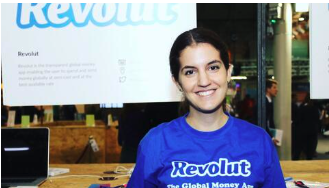
I was employee 4 at Revolut and I left before my first vesting cliff. Yes — you read that correctly.
I had a difference of opinion with Nik about direction, so I left to found Flux. This summer Revolut hit $115bn. I think about that number more than I'd like to admit. I didn't stay and I was wrong. Very wrong. Revolut is the cornerstone of my antiportfolio. What Nik, Vlad and team built is a case study of its generation, and it changed how I build for the better. For that I'm grateful.
Lesson 1: Don't make a permanent decision on a temporary emotion. Lay your plans out clearly — especially the money ones — and consider scenario modelling for calm money decisions. Also, never underestimate Nik.

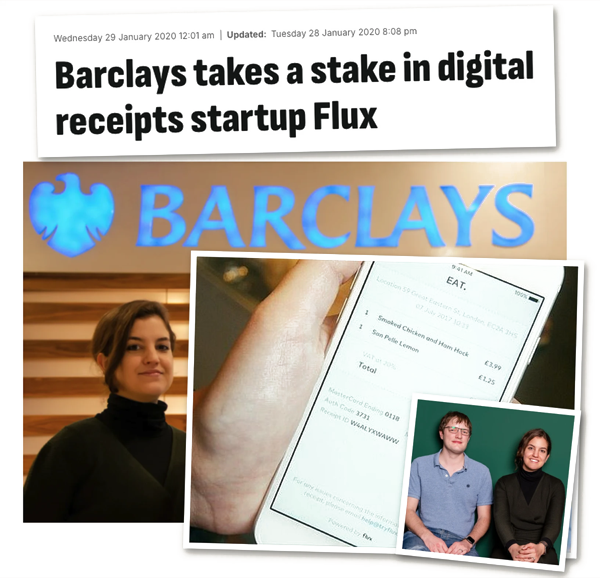
Flux launched in 2017 to build the infrastructure to digitise receipt data. We acquired 1.3m customers and built real-time integrations with giants like Barclays, Monzo, Just Eat, H&M and more so that we could close the loop.
Flux itself wasn't worth $11 billion — but we very nearly joined a home that is today. We were flying, then post-COVID we weren't so we chose to sell and signed a good deal with a US startup. Then a large partner, uneasy about data moving, pulled out last minute. The sale collapsed. I said bye to what I thought was my life's work and welcomed our 1st baby the same month. Wild.
Lesson 2: Too many to write, DMs open for founder lessons. I would highlight that crocodile mode is real. Don't be ashamed to go still when you need to but keep waiting for the right moment. When it comes, take it with force.
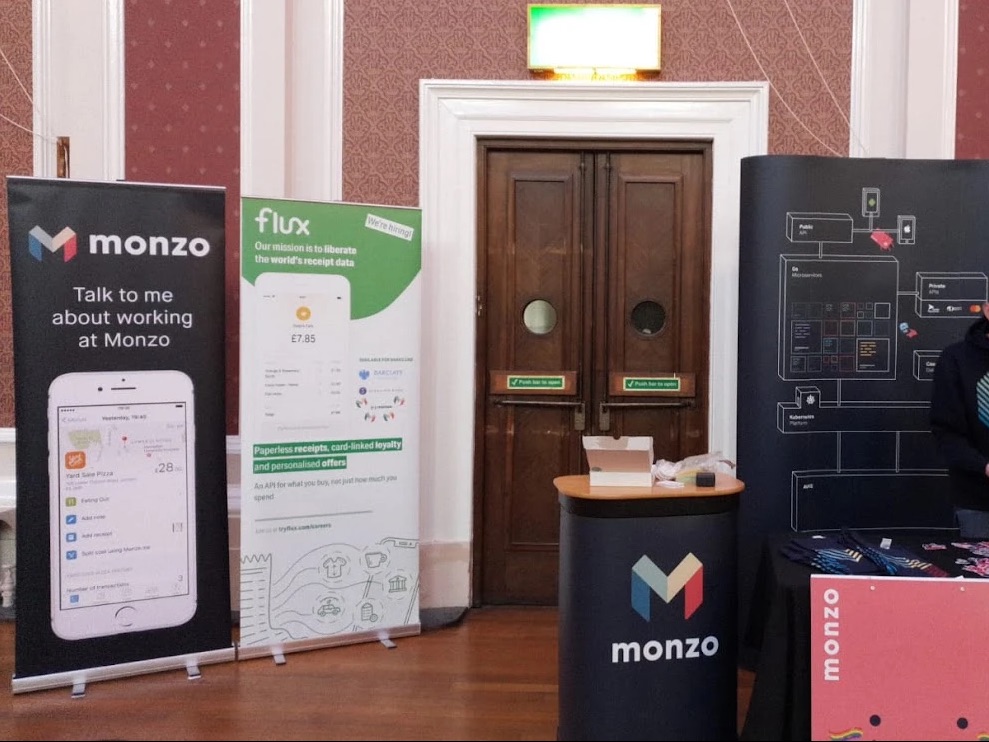
After Flux I joined Monzo and saw the magic up close — the pre-IPO stage and a real learning curve after years in 0-to-1 mode. I'm a proud shareholder 🚀 .
But the quieter shift for me over the last decade is what mattered most.
Liquidating Flux broke my lack of focus on my own wealth. I got disciplined and intentional. No exit, no windfall - just focus and consistency. Today part of my portfolio quietly covers our household utilities. Tiny against this post — but I built it deliberately, and I'm proud of it.

Lesson 3: You can't improve what you don't measure. True across everything. Obvious out loud, forgotten constantly.
3 shots. 3 extraordinary learning curves & more financial wisdom than any windfall would have handed me.
Part 2 of 6
77% of the UK working population isn't on course for a "moderate" retirement.
Moderate is £32,700 a year for a single person and £45,400 for a couple.
Even high earners aren't saved by their salaries. 61% of high-earner households are off track for a comfortable retirement.
Most of us aren't putting enough into pensions or investments like an ISA, and everyday life isn't making it easier. In the year to July 2026, regular pay rose 3.5%, while essentials like housing bills (4.6%) and fuel (15.5%) rose faster, and the UK's credit card borrowing grew 12.5%.
Candidly, I only recently cleared my credit cards and turned a corner on my own investment goals with my portfolio now paying utility bills like I mentioned in the last post. It took years. The hard news is there's no lottery ticket. This doesn't happen overnight.
The good news: financial health works a lot like physical health. With focus and the right tools, people and possibly coaches around you, small, consistent effort gets you there.
Here's what helped me turn that corner.
1. I stopped thinking small amounts didn't matter
Results compound, just like exercising every day. "I've only got pounds left after bills, so what's the point?" I hear this a lot when it comes to investing, and I used to feel the same way. But that's not a growth mindset; it's a defeatist one. So I set up a direct debit to a SIPP, Junior ISA and Investment ISA every month and never looked back.
2. I tied my spending to my goals
I got a clear view of what "good" looked like for our household spending. Ramit Sethi's Conscious Spending Plan worked for me because it balances enjoyment with discipline.
3. I learned about disciplined investing
I learn best from doers, not books. I watched Michael Taylor's UK-specific videos on investing and nerded out on Michael Alberse's Instagram where he shares how he built a passive income portfolio from nothing in the US.
4. I stopped treating tax as an afterthought
I spent real time digging into the complexity of being a US citizen and UK tax resident, invested in a great accountancy firm, and got my house in order. I stopped ignoring tax and started optimising for it.
If you're trying to figure out how you’re doing and make decisions in the 3 minute gap between kids and work, possibly hiding in the bathroom, I see you. The waitlist is now live.
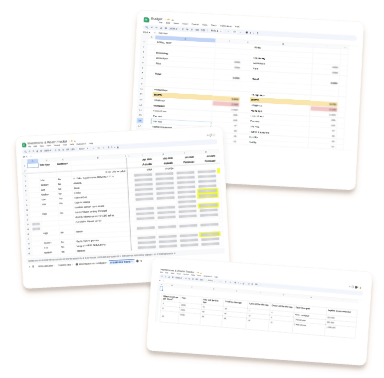
If you've got a 9-tab spreadsheet and a dozen accounts so you piece your money picture together by hand every time you need to make a decision, we're going to be best friends.
Part 3 of 6
As of now, I’m feeling great. I’ve just hit 6 figures on my personal investment portfolio because of grit and focus. Part of it generates its own cash and pays all of my monthly utility bills, neat. I can also tell you how my pension pots are doing and where I expect to be in 30 years. I can tell you how much my kids will have ready for their first home deposit or university. I can tell you a lot about my money nearly instantly.
But that wasn’t the case just 4 years ago.
The reality is there comes an age where you really need to know how you’re doing when it comes to the big picture - the really important stuff like home ownership, retirement and possibly kids. This is not about budgeting my avocado toast. I’m looking for my kindred spirits here.
But where do we start? As mentioned you cannot improve what you don’t measure. But measuring is really hard and so time consuming because of the following.
We estimate that the average UK adult has over 10 unique financial accounts across separate institutions.
I’m talking your pension pots, savings accounts, credit cards, current accounts, mortgage, home equity, personal debt and more.
Just look at these stats for starters
Asking what should be a simple question, for example "how am I doing with my savings for that thing my family needs in 2 years" so that you can make different decisions that month when payroll lands requires either
What if it didn't need to be that way? 🤔
PS — I'm hiring. I'd love to hear from strong product engineers who aren't working closely enough with AI and feel like they're missing out. DMs are open.
Part 4 of 6

So far in this series, we’ve reviewed that the average UK adult juggles 10 financial accounts and the fact that I welcomed my first child 4 years ago (I now have 2 for the record). That trigger moment made my husband and me realise we needed to fully merge our money so that we could start working as a team for the shared dreams we have for our new family.
With that in mind we doubled the accounts needed to sync up so we could plan and take action. That’s a lot of different platforms and mad complexity.
Somewhere in that blur of the newborn phase I decided that I would own it and that I needed to “mind my own business,” to borrow a line from Rich Dad Poor Dad.
As the self-appointed CFO (aka control freak) of the household, I was going to figure it out. Here’s what I did and the outcomes that followed.
📅 We started monthly family financial meetings, sometimes over WhatsApp. They're in the calendar and scheduled. We update all our numbers, review our goals, action anything off track and celebrate the focus
💸 I made sure we pay ourselves first, and that it mostly happens on autopilot. Salaries come in, money goes to Junior ISAs, our ISAs and savings accounts
🤝 Once we’ve "paid" ourselves, we each send a fixed amount to a joint account to cover shared expenses. Following that the rest of the money is to spend on life that month until the number hits zero on a debit card
🔢 I built a 9-tab interconnected spreadsheet keeping an eye on all of it. It has tabs for goals, summary, shared cashflow (what happened), budget (what we’re sticking to), pensions, investments, debts, and a few calculator tabs. The star is the summary page, bringing together our “why” and what's on/off track.
Outcome? Messy money became calm money. It nurtured psychological safety with money, networth growth and a portfolio that’s paying us a healthy amount of passive income.
Now, when it comes to money questions and getting on top of how you or we are doing, what's the solution?
I don't think it's
I think it’s a radically different approach. This is only possible now because of new technology (not just AI...) and regulatory change.
All my experiences have come together to prepare me to build this product.
My professional life chapters so far have taught me
1️⃣ Morgan Stanley: Attention to detail and discipline
2️⃣ Revolut: Execution is everything and to use conviction with hyper speed to build product
3️⃣ Flux: Resilience, hustle and the power of ideas translated into action
4️⃣ Monzo: The true definition of customer obsession
I’m pulling that all together to bring you my next big thing. I can’t wait to show you 🫶
Part 5 of 6
I’ve been quiet about exactly what I’m building. I haven’t been quiet about what brought me here. What I’m building has strong opinions about what the best product looks like and there are 2 beliefs I want to share before we hit the final post of this series.
1️⃣ “This is not financial advice” does not excuse incorrect answers, left unevaluated, with zero accountability surrounding one of the most important parts of a person’s life.
2️⃣ The knowledge and tools to build wealth and a positive net worth should not sit behind a £200k minimum.
Here’s why I feel so strongly.
28 million UK adults (56%) used AI to help manage their money in the past year (Lloyds Consumer Digital Index). Many of us are asking general-purpose chatbots to support us with our financial lives and a study of 18 AI models reported by the FT found they got personal finance questions wrong 57% of the time.
This is a problem.
Then just recently on the 19th of October, the FCA asked the providers of those models to add clearer and more consistent disclaimers because only 40% of consumers realise they have no recourse if they act on a wrong answer and it goes badly.
What does that tell me?
⭐ Consumer demand has officially outpaced the products that exist to best serve them ⭐
Confident answers, wrong more than half the time, about people’s pensions and their kids’ futures. Yet, people continue to use it because there is no alternative! Yet 🤗
Here’s what we're doing, and what I’d expect as standard:
✅ Accountability and traceability. AI is a fantastic conversational layer, never the excuse for a wrong answer. We’re accountable for every one. Every number is traceable to where it came from. Every answer is tested relentlessly against evaluations designed by qualified professionals with guardrails monitored for good customer outcomes. When it’s your life savings, “mostly right” isn’t a thing.
✅ A more inclusive business model. AI changes the economics and scale of what’s possible, so let’s use it.
My mission is to increase the wealth of every customer who uses our product, by democratising access to financial knowledge in a simple and responsible way. Nobody should need hours in a spreadsheet, a finance degree or £200,000 to know what’s going on with their money.
Part 6 of 6
It’s an acronym for “How am I doing?” and a nod to the core customer need. Everyone I speak to says the same thing: “I just want to know… how am I doing?”
Haido has one promise: know how you’re doing by talking to all of your money, via responsible AI.
I’m so proud to be back building with my co-founder Tom Reay and an elite senior team from Monzo, Deliveroo, Twitter, Just Eat and Teller.